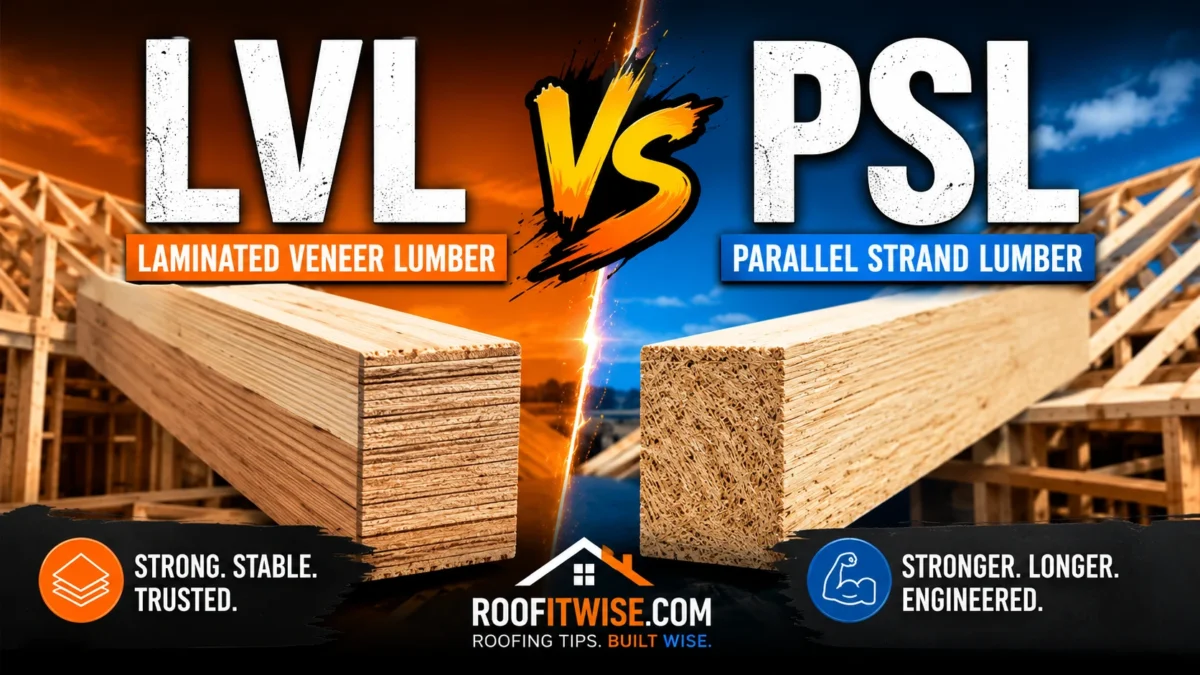
I got into engineered lumber the hard way. A contractor on a home renovation project threw out the terms LVL and Parallam in the same breath and expected me to know the difference. I didn’t. After spending time researching both properly I realised most articles online treat this as a simple comparison when the real differences go much deeper than strength ratings and price tags.
How Each One Gets Made
Microllam LVL starts as thin sheets of wood veneer sliced off logs and stacked in the same grain direction before getting bonded together under heat and pressure. The result is a consistent, predictable beam with fewer defects than sawn lumber and a smooth layered face you can see on the edges.
Parallam PSL takes a different route entirely. Long thin wood strands get aligned parallel to each other and bonded using a patented microwave process that pushes resin through the material under pressure. The finished product has a visible strand texture on the surface and a density that puts it in a different strength category from LVL.
Strength and Span: Where the Real Gap Is
LVL handles residential beams, floor headers, roof rafters and the spans above doors and windows without any issues. It performs consistently and builders like it because you can build up multiple plies on site to hit the depth you need without bringing in heavy equipment.
Parallam PSL was engineered for situations where LVL runs out of road. Long clear spans without intermediate columns, heavy commercial loads, ridge beams carrying serious roof weight. The allowable end-grain bearing stress on Parallam columns sits at 2,500 psi which is significantly higher than most dimensional lumber and puts it ahead of standard LVL in demanding applications.
Where Parallam also wins is in one-piece members. LVL often needs multiple plies bolted together to hit the required load. Parallam frequently does the same job as a single piece which cuts installation time and simplifies the structural detailing.
Fire Performance
Both materials char the same way solid wood does in a fire. Parallam PSL and LVL both carry a Flame Spread Index of 50 which puts them in Class B. That is actually better than several common sawn species including Southern Pine and Ponderosa Pine which fall into Class C. The adhesives used in both products do not cause early structural collapse. The wood fibers control fire resistance in both cases.
When to Use Each One
LVL makes sense for standard residential construction, door and window headers, floor beams, rim boards and anywhere budget and ease of handling matter. It is more affordable, widely available and easy to cut on site.
Parallam makes sense when spans are long, loads are heavy or the beams will be left exposed in the finished space. PSL has a warm natural strand texture that looks genuinely good when sealed or stained and left visible in an interior. LVL does not have that same visual quality.
For outdoor use neither standard product works without protection. Parallam Plus is the pressure-treated version built for decks and direct weather exposure without needing any field treatment on site.
Cost Difference
LSL is the cheapest of the three and LVL lands somewhere between LSL and Parallam on price. Parallam PSL costs the most of the three, reflecting its manufacturing complexity and strength output. A 1.75 x 9.5 LSL runs around $7.43 per foot while the same size in LVL comes to roughly $9.04 per foot. Parallam goes higher again but on large span projects the savings from eliminating intermediate posts and reducing installation labour often close that gap quickly.
Also Read: