I am Mayuri and engineered lumber was not something I expected to find interesting. A renovation project changed that. The contractor kept switching between LSL and LVL like they were interchangeable and when I asked why he used one over the other the answer was longer than I expected. That conversation is essentially this article.
How Each One Gets Made – LSL vs LVL Lumber
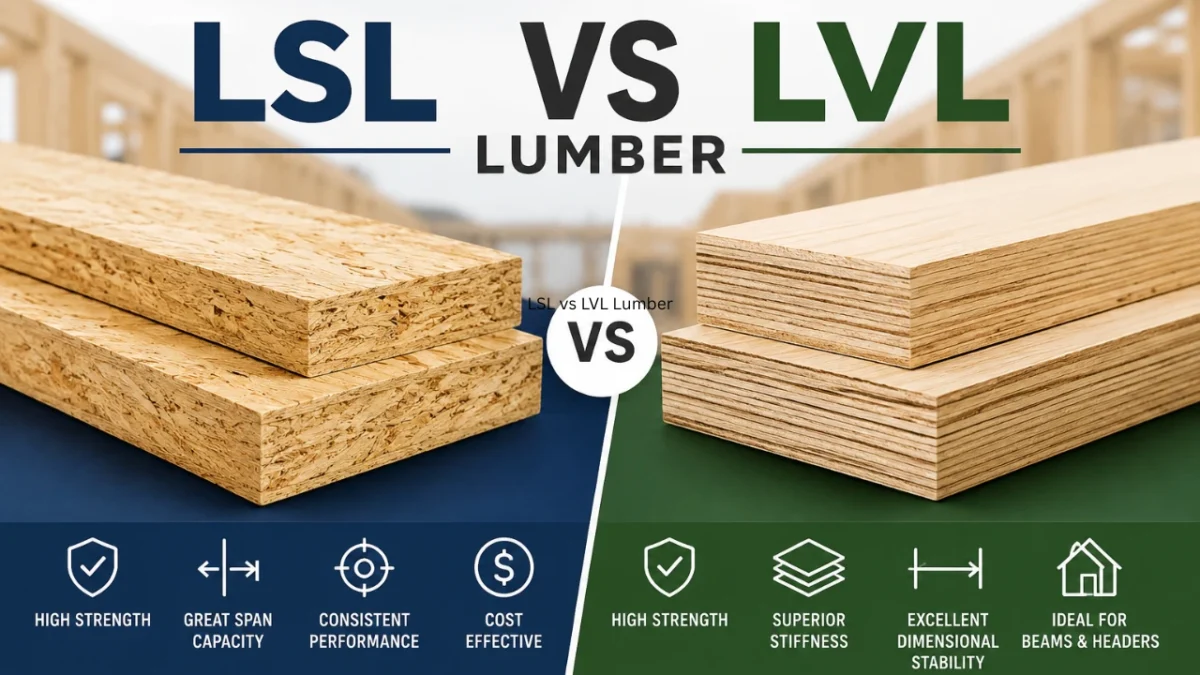
LSL starts with strands. Long ones, pulled from the wood and pressed together with resin under serious heat. From the side it honestly looks like someone compressed a pile of wood chips – but hand it to a framer and it performs like proper lumber.
LVL is a different process entirely. Thin veneer sheets, stacked, glued, pressed. Every layer’s grain runs the same direction and that repetition is exactly what gives it the strength it has. My contractor picked up a scrap piece once and showed me the edge. Neat lines running through it, each one a veneer sheet. He said nothing. Just let me look at it for a second before moving on.
Same category. Very different construction.
Strength: Where the Gap Actually Shows Up
LSL handles wall studs, rim boards, door and window headers without any trouble. Moderate to good strength, consistent performance, no surprises. For most interior framing work it does everything you need.
LVL is in another tier. Long spans, heavy floor beams, roof systems carrying serious weight – that is where LVL goes. The grain alignment across every veneer layer compounds into bending strength that LSL simply cannot match at the same dimensions.
The practical test: if a beam needs to cross a large opening without a post underneath it, that job almost always goes to LVL.
Cost and What You Actually Get for the Difference
LSL costs less. A 1.75 x 9.5 LSL runs around $7.43 per linear foot. The same size in LVL comes to roughly $9.04. That gap matters on a full framing job.
But here is what builders know that spec sheets don’t say clearly – LVL often replaces two or three built-up LSL members. If you would need three LSL plies bolted together to hit the required load, a single LVL piece does the same job faster and with less hardware. The upfront cost difference shrinks once you count labour and fasteners.
Workability on Site
LSL cuts and nails like traditional lumber. It behaves predictably and anyone comfortable with standard framing handles it easily.
LVL is denser and heavier. Handling longer pieces needs two people. Cutting takes a sharp blade. It is not difficult but it is not the same as framing stud walls either.
Which One to Use
LSL for studs, rim boards, short headers, interior framing where the loads are moderate and budget is a real constraint. It stays straight, it machines well, and it does not cost you the job.
LVL for anything spanning long distances, carrying floor loads, or sitting inside a structural system where failure is not an option. Garage door headers. Ridge beams. Floor systems in a building with more than one storey. That is LVL territory and most engineers will tell you not to substitute something else in those spots.
One material is not better than the other. They just answer different questions.
Also Read: