Today, the roof of a house is not just a covering; it expresses the beauty, durability, and architectural taste of the house. Among the different types of roofs, the “Hip Roof” has become very popular today.
At this time, many people want to know: What is a Hip Roof? A hip roof is a roof that slopes from all sides of the house and meets at the top. That is, the roof rises from all sides and finally meets at one place to form a peak. This type of roof looks beautiful and balanced. In addition, the hip roof protects the house well from the weather. Therefore, it is used as an effective roof not only from an architectural point of view, but also from a durability point of view.
The use of hip roofs dates back to ancient times. Use of hip roofs is very common across Asia and Europe, where homeowners install them to protect their houses in extreme weather conditions such as thunderstorms or heavy torrential downpours. The roof is known for withstanding the test of time as it is strong and durable.
In modern times, hip roofs are being widely used in new houses, bungalows, resorts, and urban modern architecture, because they are effective and durable on the one hand, and aesthetically attractive on the other. We will now learn in detail about this- the type, structure, advantages, disadvantages, and uses of hip roofs.
What Is a Hip Roof?
A hip roof is a roof where all four sides slope downward toward the walls.
Unlike a gable roof, which has two sloping sides and two flat triangular ends, a hip roof has no vertical ends. All sides slope downward and meet at a ridge or a single peak.
Think About It Like This
- Imagine a cardboard box.
- Now imagine folding all four top sides upward until they meet in the middle.
- That’s basically what a hip roof looks like.
Simple Illustration
      /\
     /  \
    /----\
   /|    |\
  /_|____|_\
Every side slopes downward.
That’s the key feature of a hip roof.
Why Is It Called a Hip Roof?
The word “hip” refers to the outside angle where two roof slopes meet.
The diagonal lines running from the corners of the house to the roof peak are called hip rafters.
Basic Structure of Hip Roof
The most important feature of a hip roof is its four slopes. The roof slopes down on each side and meets at the top in a ridge or peak. It usually has four sides: two main sides and two end hips.
The shape of the roof distributes the pressure evenly, so the basic foundation of the house remains stable during cyclones and heavy rainfalls in the monsoon. That is why the architects often suggest the installation of hip roofs, as that is the safest option to go to in coastal areas where typhoons and strong winds are very common.
Hip Roof vs Gable Roof
This is the comparison my dad explained most often.
| Feature | Hip Roof | Gable Roof |
|---|---|---|
| Number of Slopes | 4 | 2 |
| Wind Resistance | Excellent | Good |
| Rain Drainage | Excellent | Good |
| Construction Cost | Higher | Lower |
| Attic Space | Less | More |
| Appearance | Premium | Traditional |
| Structural Strength | Stronger | Less Strong |
Real-Life Example
- Imagine holding an umbrella during a strong wind.
- A hip roof is like a rounded umbrella that lets wind flow around it.
- A gable roof is more like holding a flat board against the wind.
- Which one catches more wind?
- The flat board.
That’s why hip roofs generally perform better in windy areas.
Different Types of Hip Roofs
Many people think all hip roofs look the same.
That’s not true.
Here are the most common types.
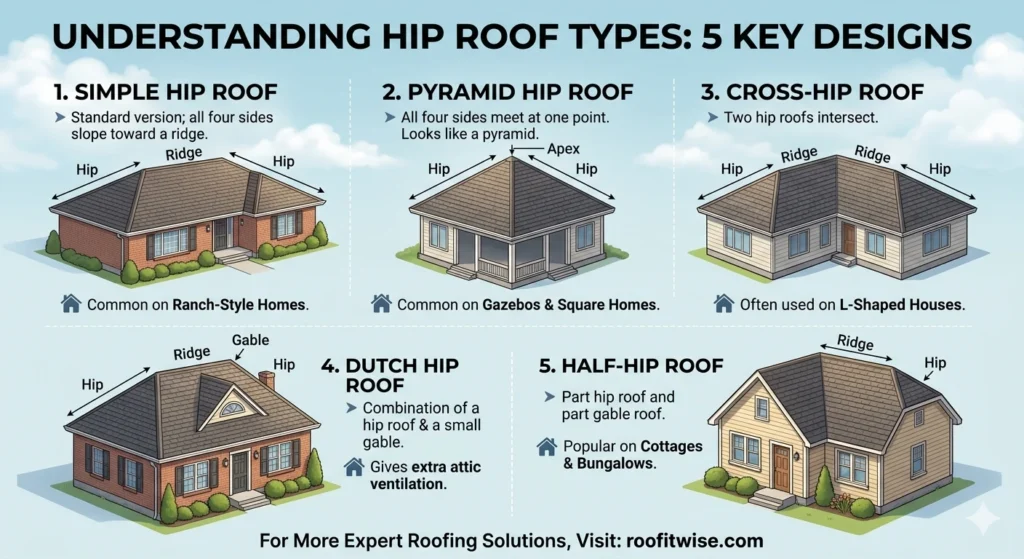
1. Simple Hip Roof
This is the standard version.
All four sides slope toward a ridge.
🏠 Common on ranch-style homes.
2. Pyramid Hip Roof
All four sides meet at one point.
It literally looks like a pyramid.
🏠 Common on gazebos and square homes.
3. Cross-Hip Roof
Two hip roofs intersect.
🏠 Often used on L-shaped houses.
4. Dutch Hip Roof
A combination of a hip roof and a small gable.
🏠 Gives extra attic ventilation.
5. Half-Hip Roof
Part hip roof and part gable roof.
🏠 Popular on cottages and bungalows.
Advantages of Hip Roofs
The main reason for the popularity of hip roofs is that they are beneficial in many ways.
- Wind resistance is high because the roof is sloped on all sides, so the wind cannot hit the roof directly, but rather easily moves sideways.
- It facilitates water drainage. Due to the sloping structure, rain or snow easily rolls down, so water does not accumulate on the roof.
- Gorgeous design- This roof structure enhances the exterior beauty of the house many times over.
- Long-lasting and durable hip roofs are usually built on strong structures that last for years.
Difficulty
Although hip roofs have many advantages, they also have some limitations.
- Construction costs are high. Due to the slope on all sides, the structure becomes complex, and the need for materials is also high.
- Difficult to maintain due to the complex design, repairing or replacing the roof is relatively difficult.
- Attic space is limited, but there is space inside. But the full height cannot be used due to the sloping walls.
Comparison Between Hip Roof and Gable Roof
Many people confuse hip roofs and gable roofs, but there are many differences between these two designs.
- A gable roof has two sloping sides and two straight walls at the ends, and a hip roof slopes on all sides. So, there are no straight edges.
- Wind pressure is higher on a gable roof, but on a hip roof, the pressure is distributed evenly around the roof.
- The hip roof looks more attractive and balanced.
This is why many architects in modern architecture are choosing hip roofs instead of gable roofs.
Hip Roof Pros and Cons Summary
| Pros | Cons |
|---|---|
| Strong wind resistance | Higher cost |
| Great water drainage | More complex construction |
| Strong structure | Less attic space |
| Attractive design | More labor required |
| Better snow performance | More potential leak points |
Steps of the Construction
The following steps are generally followed to build a hip roof.
- The roof design is determined according to the shape, length, and width of the designed house.
- Frame Construction: The main structure of the roof is usually made of wood or iron frames, which give the entire roof a solid foundation.
- Rafter Installation: Rafters or roof trusses are placed at specific angles according to the direction of each slope, so that the roof can maintain balance.
- A slope is created by placing sheet, tiles, or shingles on a sheet or tiled roof.
After the finishing and drainage system is completed, gutters or pipes are installed to drain water.
Evolution and Practical Aspects of Hip Roofs
While building a house, the question arises: What is a Hip Roof, and why do people prefer it? In reality, a hip roof is basically a roof that is the perfect blend of durability and aesthetics. The history of the hip roof is very old. This type of roof was used in medieval Europe and ancient architecture in Japan. In ancient architecture, where facing the adversities of nature was a big challenge, hip roofs were a symbol of security.
Nowadays, this type of roof is increasingly used in modern houses, offices, and even government buildings in urban areas. It is especially useful in monsoon-dominating countries because the sloping structure allows rainwater to drain easily.
Materials Used in Hip Roofs
Various materials can be used to construct a hip roof, such as:
- Concrete or Cement Tile: For making a long-lasting and heavy roof.
- Metal sheet or Tin: Lightweight and easy to install.
- Clay Tile or Terracotta for traditional beauty.
- Asphalt Shingles: Modern and sustainable solution.
Maintenance
To upkeep the roof and make your family feel safe under the hip roof of your house, you need to do the following:
- Cleaning of the roof after every few months to stop the water and dust from accumulating.
- Check the paint coating, and if found damaged, then don’t be late in repainting the area.
- If the slope or rafter is wobbly anywhere, it should be fixed quickly.
Proper maintenance greatly extends the life of a hip roof.
Final Words
The beauty of a hip roof is its simplicity. The slope on all sides gives the house balance and also protects it from the elements. As a result, it is not only practical but also a great example of modern architecture from an aesthetic point of view. So if you are thinking of building a new home, a hip roof is an option worth considering.
In a word, if someone wants to know what a Hip Roof is, then it can be said that it is a type of roof that slopes on all sides, protecting the house from the adversities of nature and completing the beauty of the house. This is why it has become an essential part of architecture around the world today.
Also Read: