I’m Mayuri, and I ran into this comparison the same way I run into most lumber questions, through a contractor who assumed I already knew the answer. We were talking about a renovation with a vaulted ceiling and he casually said “you’ll want glulam there, not LVL.” I asked why.
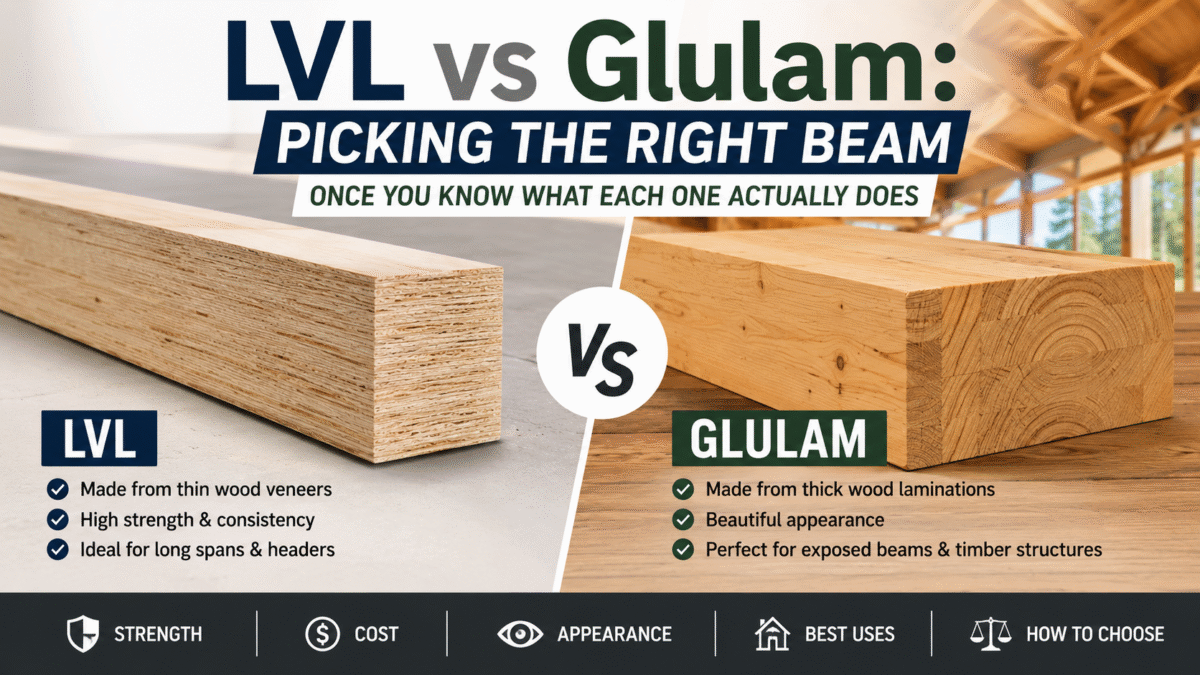
LVL vs Glulam – How They’re Actually Made
Nothing exotic, just lumber you could pick up at any yard, glued together with the grain all pointing the same way. Bend those boards before the glue sets and you get the curved arches, churches lean on this trick a lot, so do sports arenas.
LVL skips boards entirely. LVL skips boards entirely and works with veneers instead , thin sheets, roughly a tenth of an inch, pressed under heat with the grain lined up the same direction.
Both showed up to solve the same shortage. Big old trees were disappearing from the supply chain and somebody needed a way to pull real strength out of whatever was left, younger, thinner, less impressive looking timber.
Strength Numbers That Actually Surprised Me
I didn’t expect LVL to beat glulam this clearly. Beech LVL, the high-performance kind sold as BauBuche, has a breaking length of 8.3 kilometres. Spruce LVL comes in at 8.0. Glulam sits at 4.4. Structural steel, for comparison, manages 3.2.
Glulam still wins where it counts most for big buildings, though. For spans past 30 metres, glulam is the standard choice. LVL caps out around 24 metres. Past that point it just isn’t the right tool anymore.
One more thing in LVL’s favour is it barely warps. Stacking veneers means knots and weak spots get scattered and diluted instead of sitting in one place waiting to cause trouble.
Looks Matter More Than You’d Think
Here’s where the two completely split. Glulam gets specified specifically because it looks good. Vaulted ceilings, exposed church beams, anywhere a beam needs to be seen and admired, that’s glulam territory. It even comes in four appearance grades, going from basic framing up to premium finish.
LVL was never meant to be seen. It lives inside walls, inside floors, doing structural work nobody will ever look at directly. Functional, not decorative.
Fire and Moisture
Both hold up better in fire than people expect from wood. Glulam chars slowly. About a fortieth of an inch a minute, give or take. That blackened outer layer isn’t damaged exactly, it shields whatever wood is still underneath. Want a one-hour fire rating instead of the standard? Swap in one extra tension lamination at the base and you’re there.
Moisture is where LVL pulls ahead. A Forest Products Laboratory study found LVL holds up better than solid-sawn glulam under harsh exposure. Glulam’s varied ring angles create more internal stress, which roughly doubles the splitting and delamination compared to LVL.
Price and Where Each One Belongs
A 3.5 x 9.5 LVL runs about $20.71 per foot. Glulam at the same dimensions, 24F-V4 grade, comes in slightly cheaper at $18.35.
LVL for headers, floor joists, rim boards, anything hidden and standardised. Glulam handles the long spans, the curved roofs, and the bridges. Also the situations where the beam has to carry weight and still look like it belongs there. Pick one over the other and you haven’t really chosen a winner. You’ve just matched the tool to the job in front of you. Neither one replaces the other. They were built to solve two different problems.
Also Read: